CommissionING
STAINED GLASS FOR HOSPITALS

The sound of soft rippling water. Calm golden light warming the room. A place to find your thoughts. You are in a chapel, in a hospital. Matters of the soul are at hand: Medicine, healing, disease, new-born life. What distinguishes this room is the quality of light stained glass brings to a healing environment, a hospital chapel or even a hallway. Patients are calmed by luminous color, quiet passages, spaces which comfort, floors which bring healing into lobbies and waiting areas. Deep-running emotions spring from flow, color and movement. Physicians and staff love walking by this stained glass every day. An art program in a healthcare environment does the work of essential healing. It affirms the soul.
Why Light Matters in a Hospital
If any architecture needs help, it is a hospital. The buzz of fluorescent ballasts, drop ceilings, the almost sickly off-green glow of artificial lighting do not speak to the wellness or wholeness of a person. The glow of daylight, of sun, of luminous color is what a built environment thirsts for. The touch of a hand, the caring gesture, the human connection, that comes through in stained glass. The recognizable movement of brushstrokes, the relatedness of form. It is a gesture of touch, of healing. People get that. They get the luminous, painterly qualities in the work I do. It feels like a watercolor, but it glows. It has life. The work gives life.
Two Healthcare Commissions
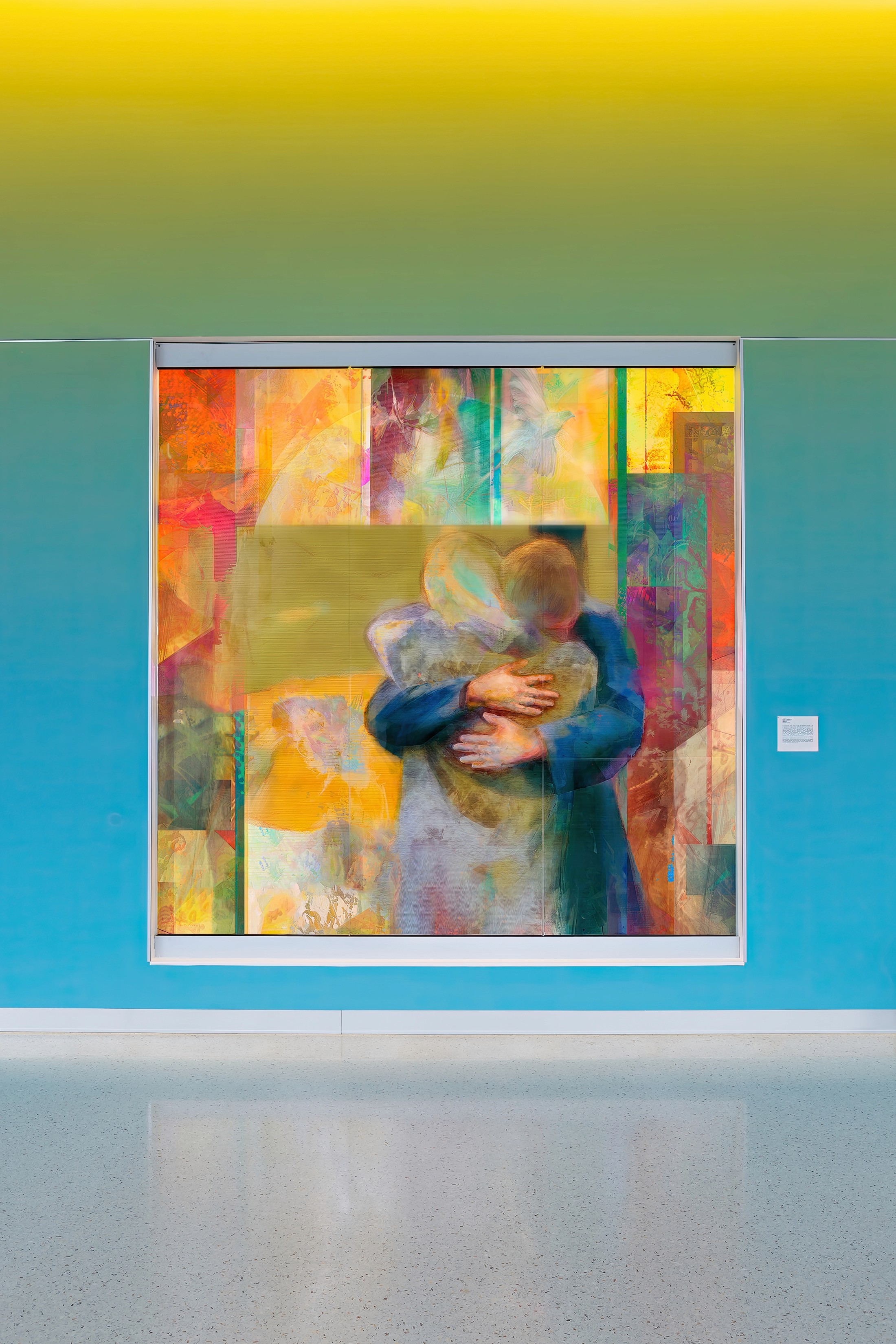
In Duluth, Essentia was building an entirely new hospital overlooking Lake Superior. The architects understood the views, and the light. And the chapel placed along a gently curving wall would see lots of people walk by, or in. The stained glass is seen from inside and outside, both sides. The Benedictine Sisters wanted to tell a very old story of a brother and sister’s final embrace. That hug, that most human of gestures is conveyed in my design. When we spend time looking, we can be drawn into the process of the glass making. The glass is mouth-blown, as it has been made for centuries, but pieced together with such great precision by hand, that it is made without lead lines. The glass feels clean, it is warm, the language contemporary and universal. And the color transports you, ever-changing due to the angle of the sun, time of day, season of the year. Light that moves. Forever new.
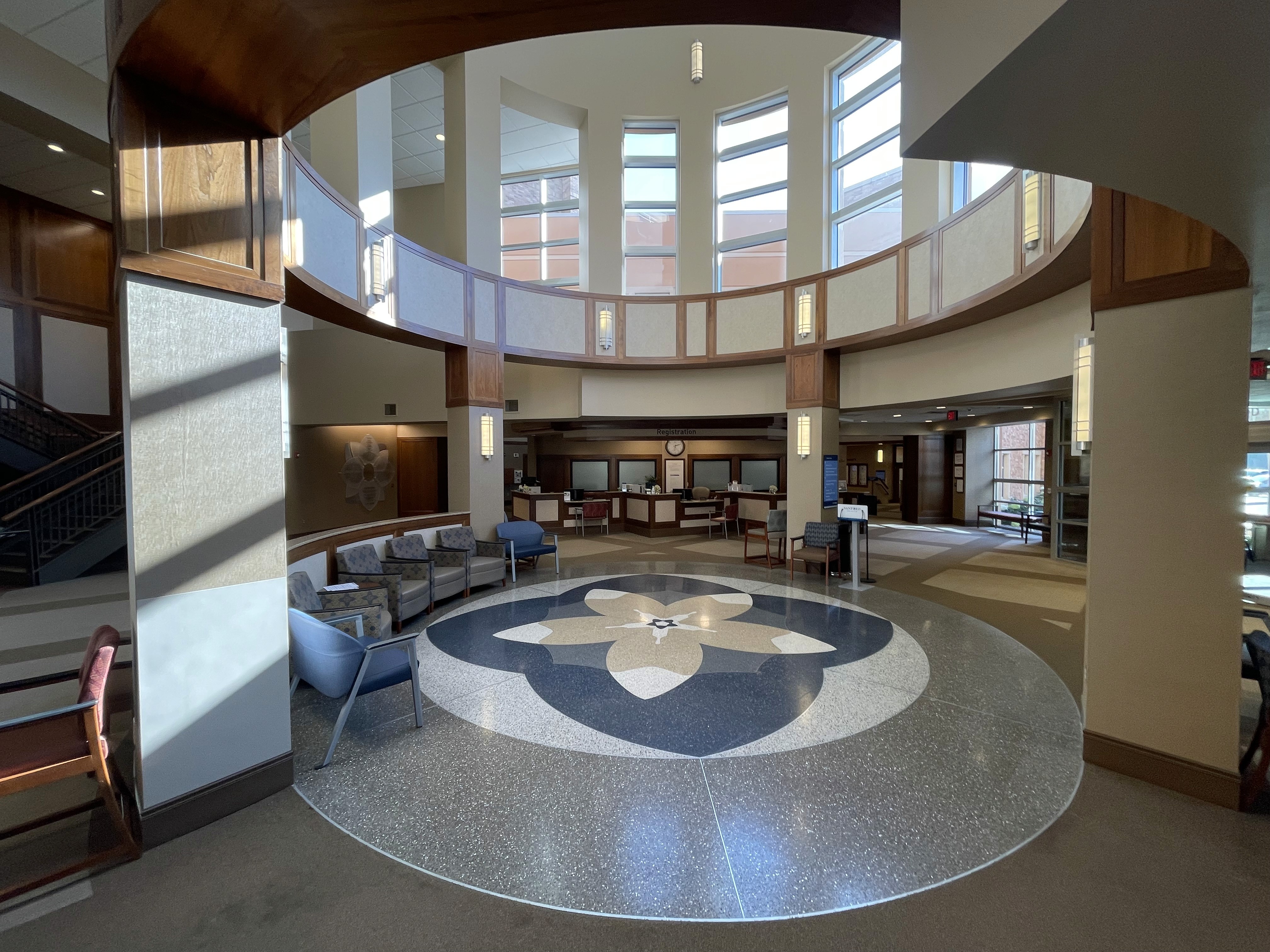
In Sioux Falls, a new Edith Sanford Breast Center was being built, and the lobby areas needed a calm anchoring identity for those who would come, gather, wait, sit, and talk. I proposed two terrazzo floors, round in shape, with healing as the message. Nearby prairie flowers with traditional and modern uses in medicine create the symmetry and floral patterns. Specks of mica, and glass, and seashell make the floor glint and sparkle, projecting a glimmer of ever-changing specular features throughout the day and year. The floor is epoxy terrazzo, it is industrially solid, and will outlast the life of the building with ease.
The essayist Brian Doyle once observed that which we call common is miraculous. Both of these artworks take moments and symbols of everyday interactions in a hospital, in these two cases, flowers and hugs, which are treated with reverence and awe, to let you know such things are indeed important, and memorable, and necessary. That miracles are normal. And healthcare workers know hospitals need miracles. Reminders of outcomes that heal. Art is the accompaniment to this process. It has a presence which points beyond itself. An embodied presence that crosses the mysterious threshold—reconciling the material with the spiritual.
How a Healthcare Commission Works
Each commission is foremost for me an opportunity to learn. And it is an opportunity to bring the voices and stories of a place forward. I will meet with you, I will listen to who will be in the space, the healthcare workers, chaplains, nurses, the art committee, sometimes patients and families. What everyone says informs where I even start.
I will also look at the site conditions, the architecture, the building materials, the finishes, lighting plans. I look at orientation, at what the glass faces, at what the light does in that space through the day and through the year. A north-facing window and a south-facing window have very different requirements.
I usually create a couple of concepts, sometimes if it’s so aligned that it feels so right, I may just present one idea. The presentation is visual, accompanied by words. The committee sees the renderings and their feedback is critical. I use these responses to modify or make changes. Sometimes we hit it right the first time. I design collaboratively. The final artwork will be uniquely yours. Once final drawings are approved, usually one or several sample panels at 100% scale are produced and reviewed on site in the same lighting conditions.

Design proposal for a hospital chapel. Concept rendering.
After design and sample approvals, the glass studio will produce full-scale drawings and begin color tests. A thorough foundation is set for the project by the time painting begins.
The glass is created and painted by studios in Germany. Lamberts makes the mouth-blown glass and painting is by Derix Glasstudios in Taunusstein, Germany, a studio I have worked with for more than twenty years. The painted layers are produced with vitreous enamels and fired multiple times in the kiln. The bonding is at a molecular level. Colors do not fade, even in harsh light. Larger commissions involve travel, smaller ones are coordinated through my studio with zoom and emails.
Panels ship upright in specialty crates built by the studio. For installation, I often work with a local glazier, but sometimes we will bring an installer in from the glass studio. The timeline for a commission of course varies with each project, but as a guideline, allow for 10-18 months from first conversation to installation.
Materials and Durability
Glass choices, the materials, techniques, stenciling, acid-etching, even the paint application will vary based on everything I’ve described here. For most projects I have used mouth-blown glass from Lamberts in Bavaria. It is painted, fired, and laminated to a float glass carrier panel at Derix Glasstudios. The finished panels are tempered and will meet all safety, architectural and building code requirements. The art glass panel can be built into an insulated glass unit (IGU), fabricated at Derix or assembled by a local glazier. Sometimes the art glass is installed as a third layer to the interior of the IGU as a breathable third panel.
All glass projects are CAD-drawn and specified in shop drawings with structural engineering approvals.
Maintenance is similar to any other glass curtain wall. There is no lead came in my work, so there is no putty to dry out and replace.
Get in Touch
If you are considering stained glass, or planning a hospital, a chapel, a cancer center, a healing garden, reach out to contact me. I am happy to look at the possibilities with you. Architects, art committees, facilities directors, and donors are all welcome. I can make meaningful suggestions in the design-development if brought in early, or if you have an existing building you might want to add architectural art glass, that I can help you with in your planning. I am fluent in Spanish and welcome inquiries from Spanish-speaking communities.

Stained glass at the Aurora Recreation Center, part of a broader wellness and community practice.