Field Notes
How Stained Glass is Made—And Why I Work in Germany
I think quite simply that glass is the most beautiful material on the planet. It is light made visible. Looking into a piece of mouth-blown glass can anoint your eyes with wonder.

Glass begins as three earthly materials: silica (quartz) sand, soda ash, and limestone. These are the ordinary materials of beaches, oceans, and rocks, yet they also carry a larger sense of time and space, since they are found in asteroids and in 50-million-year-old lakebeds. From these basic elements of the universe comes the magic.
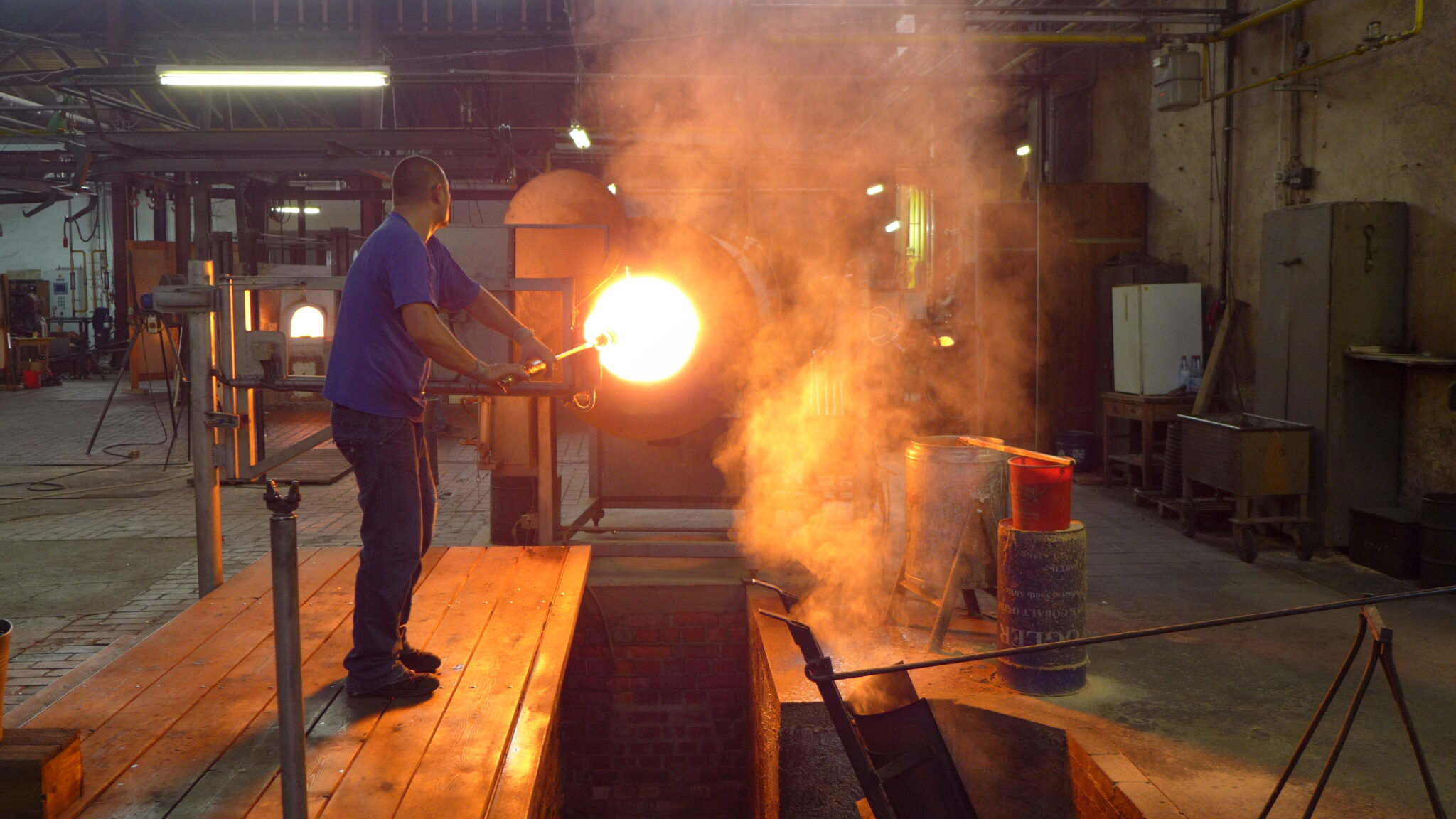
Glass blowing began over 2,000 years ago in the Levant region of Syria, Israel and Lebanon. For my story, the magic starts at Lamberts Glashütte in Waldsassen, Germany. Bavaria has long been a center of glass production because its forested mountains once supplied the wood needed to feed the furnaces. Natural gas is used now.
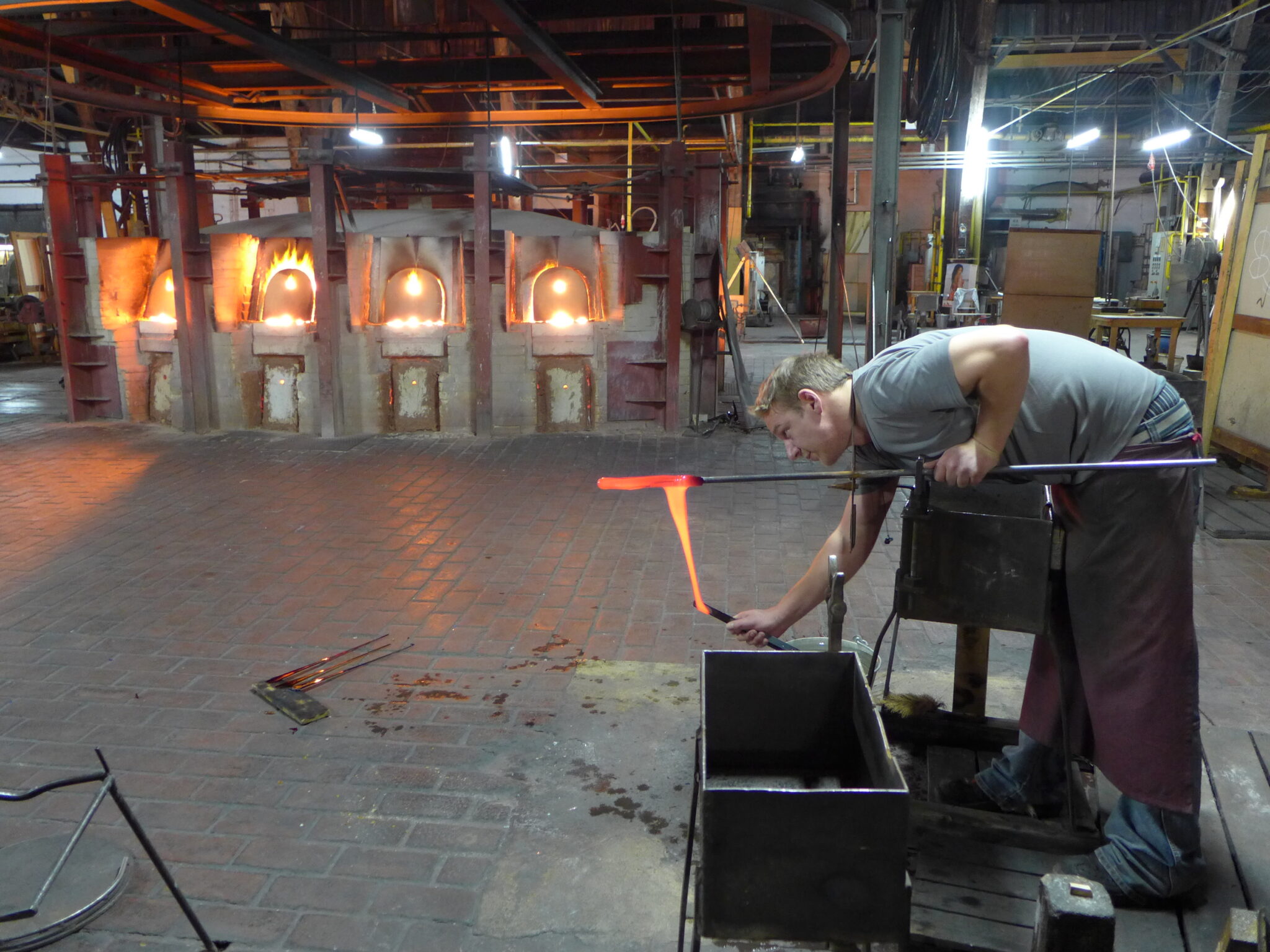
The glass-making process begins the evening before the glass is blown, when the furnaces are brought up to 1450 degrees Celsius and the metals that will color the glass are introduced to the melt. It takes 14 hours to bring the furnace up to temperature. Color tests are pulled through the night to make sure the chemistry is right. By morning the glass is ready.

The glass begins as a small bubble (the parison) on the end of a blowpipe, blown into a balloon and constantly rotated by hand. Watching the entire team blow glass is like watching a well-choreographed ballet, each person moving in relation to the others with a precision that comes from long practice.

When the glass balloon reaches a certain size, it is handed off to another glassblower, who enlarges it further into what is called a gather. The gather is then shaped in a marver trough as it is spun. Metal protrusions in the marver trough create beautiful textures in the glass.

When the gather reaches the right size, the blowpipe end is knocked off. It is heated again, the other end is cut off, and a cylinder comes into existence.

These cylinders are then reheated and sliced vertically. In another furnace, a glassworker slowly flattens each opened cylinder into a sheet using a wooden block on the end of a shaft. The block used to flatten the sheet leaves faint marks in the glass, adding to the charm of the mouth-blown, hand-finished surface. Once the glass is unrolled, it is annealed (slowly cooled to remove internal stresses).

I love when glass retains the evidence of its making, grooved like flowing lava from its fiery, volcanic origins. The depth and texture inherent in this glass-making process is extraordinary.

I have seen when the sun strikes an air bubble inside the mouth-blown glass at the right angle, you can sometimes see a prismatic rainbow appear inside the glass itself. The traditional method of Lamberts’ hand-blown flat glass production was recognized and awarded UNESCO Intangible World Cultural Heritage status in 2023.

The energy and movement, especially in the streaky flashed glass produced directly in the furnace, has been an ideal starting point for creating the structure in my glass designs. The sublime, flashed nuances move from the realm of traditional craft into what I see as a threshold of greater mystery. Twice I have had the good fortune to take my students to Germany to visit Lamberts and see the glass being produced.

I have had the pleasure of knowing Christian Baierl, Lamberts’ Managing Director, through dinners and conferences over the years. He is good company and a genuine steward of what this studio is.
How Stained Glass Is Painted

Before becoming glass, my designs are created through a fusion of Photoshop and watercolor work. I love the spontaneity and unexpected interaction of pigment with water and grain of the paper. In glass painting we try to do the same thing by suspending the vitreous enamels in liquid media, often in water or sometimes a solvent. I bring my designs from my studio in South Dakota to Derix Glasstudios in Taunusstein, Germany. We work through glass samples and color tests, client approvals, and full-scale cartoons. By the time the actual painting begins, the research is done, many decisions have been made, and the direction is clear. This is a German studio and their rigor is what makes this work possible.

This is part of a series of windows I designed for the glass curtain wall of a swimming pool for a recreation center in Colorado. The design, called the cartoon, is printed out at life-size at full-scale.

Sample panels of all areas will be created. Typically one or several 1:1 sample sections are sent to the client for approval as well.

One of the most enjoyable parts of the entire process is choosing the glass. Sometimes I order specialty glass from Lamberts just for a particular project, but at Derix there are walls and walls of mouth-blown antique glass: colorful, jewel-like and luminous, to choose from. It’s like going to the candy store. You are choosing a local color for each area of the design: green in this section, blue in that one, pink there. This is akin to planning the color of your washes in a watercolor painting.

Glass painting is a layered art. There is no fixed sequence that applies to every window. Each commission requires its own plan, a thinking-through of colors and techniques in layers.
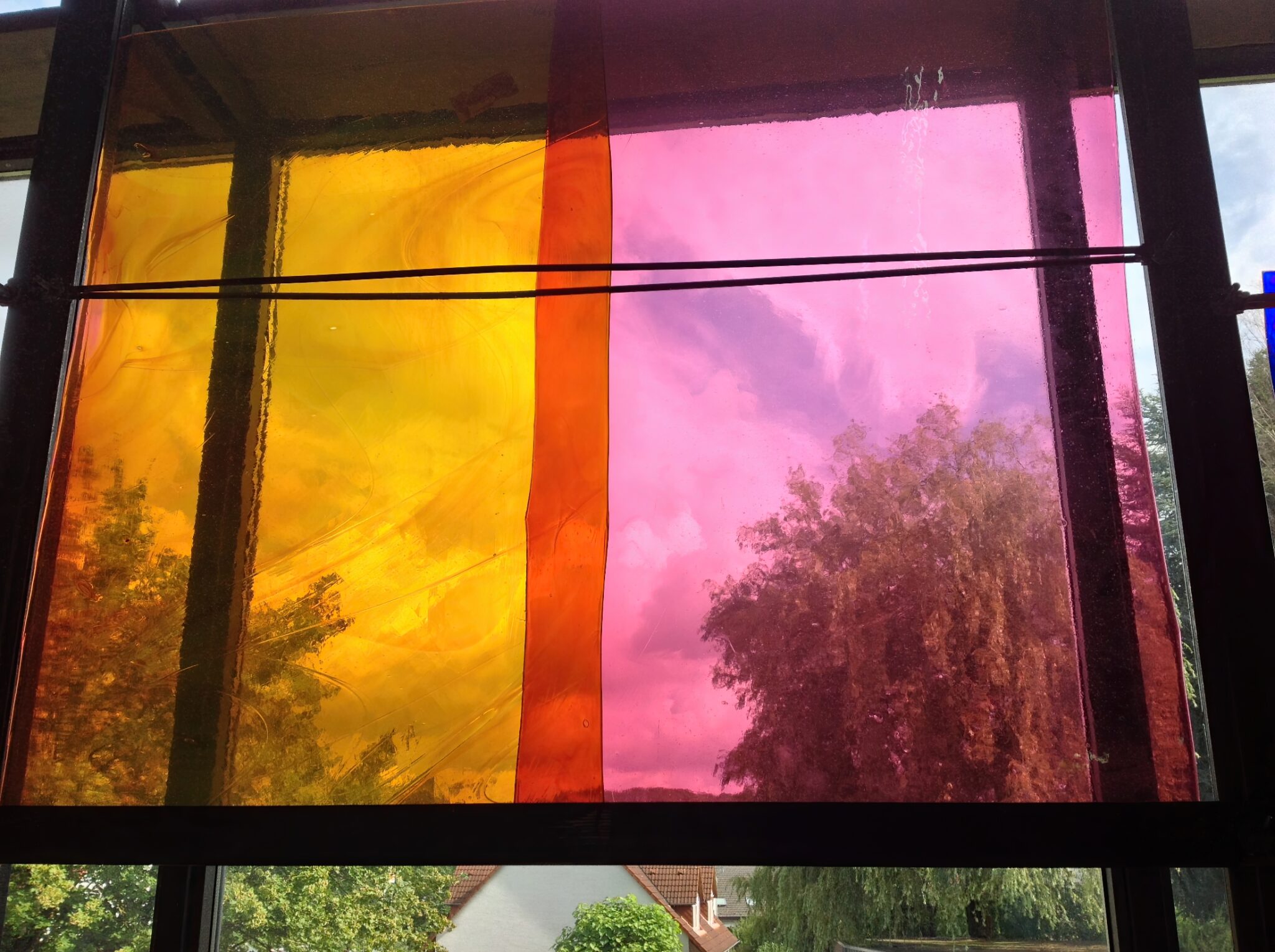
That fiery orange does not result from mixing pigments alone, it comes from the way light passes through both the pink and yellow glass sheets. It is light that gives glass its interior life.

Often, an early set of decisions involves silver stain. Silver nitrate mixed with earth is painted or airbrushed onto the glass and then fired in the kiln. The next morning you wipe away the dirt, and what remains is a deep amber yellow that has flowed through the glass to stain it from within. There is something alchemical about this process. As Monsignor Buelt has written, this is an incarnation in miniature, the earthly material become luminous.

Flashed glass is made by blowing a thin layer of colored glass over a base of clear or lighter glass, creating two distinct layers. Acid etching is often used to reveal what lies beneath. The glass is immersed in hydrofluoric acid, which begins to remove the top layer of color and reveal more of the layer underneath. If the glass is flashed with a color over clear, then the color will lighten in value.

Some colors etch away in minutes, like certain blues; others take hours, like some of the reds. Sandblasting achieves its own effects. When applied from the back side of the glass, it creates a softer, more matte quality of surface that diffuses the light.
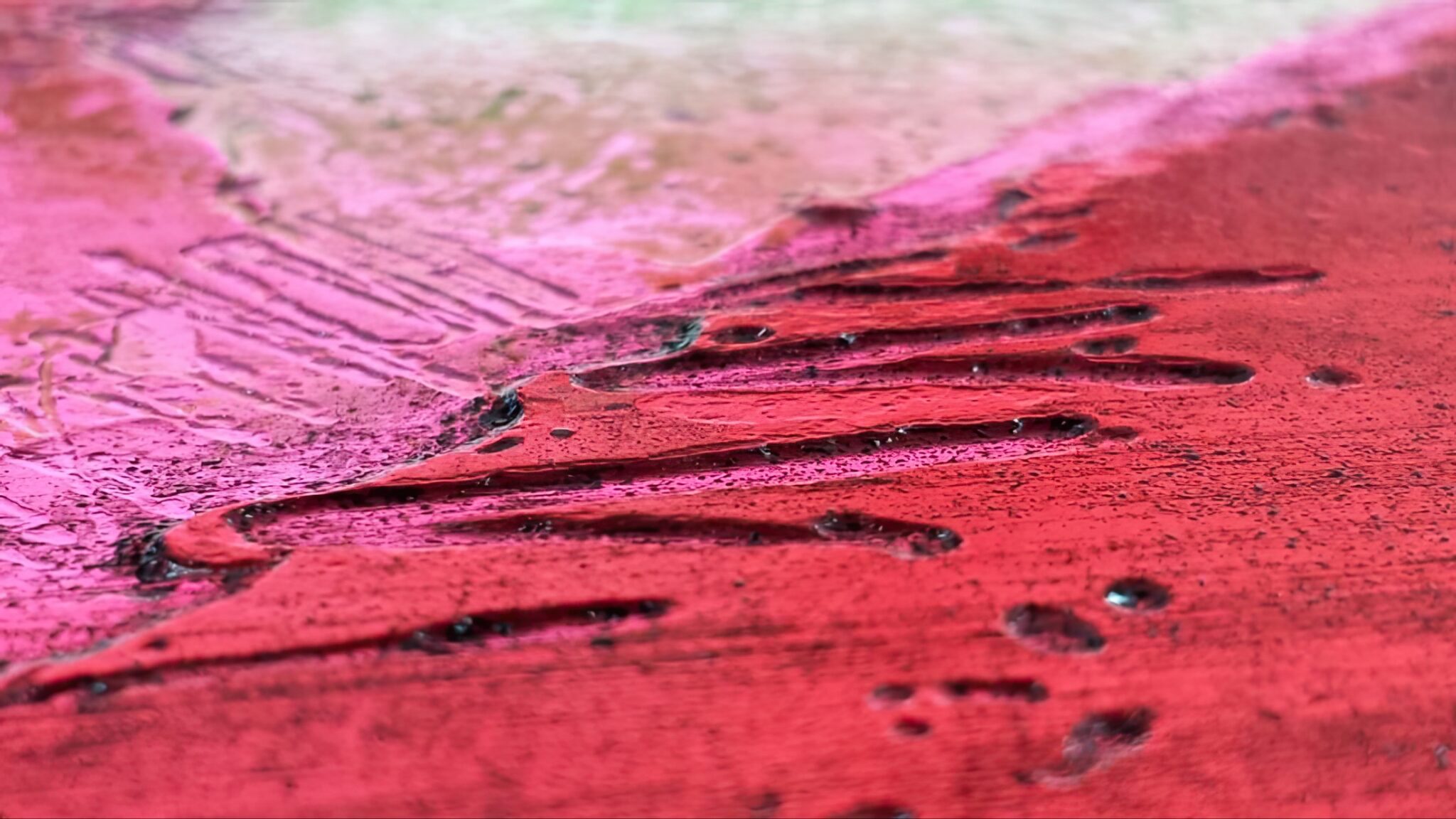
The image above shows a detail of how sculptural the surface of the glass becomes after several stages of acid-etching. An aqueous pigment was then rubbed into the resulting grooves and brushed away to highlight the three-dimensional form and fired into the glass.

Glass painting can be done on antique (mouth-blown) glass or on modern architectural plate glass. Vitreous enamels are often transparent and interact with everything beneath them: stain a field yellow, paint red over it, and you have orange. These are iterative, informed, and compounding decisions. Each choice opens some possibilities and closes others.

Upon firing, vitreous enamels bond to the glass and become molecularly part of the material itself. The colors will not fade. Depending on the design, a glass panel may be fired several times, maybe up to five times maximum.
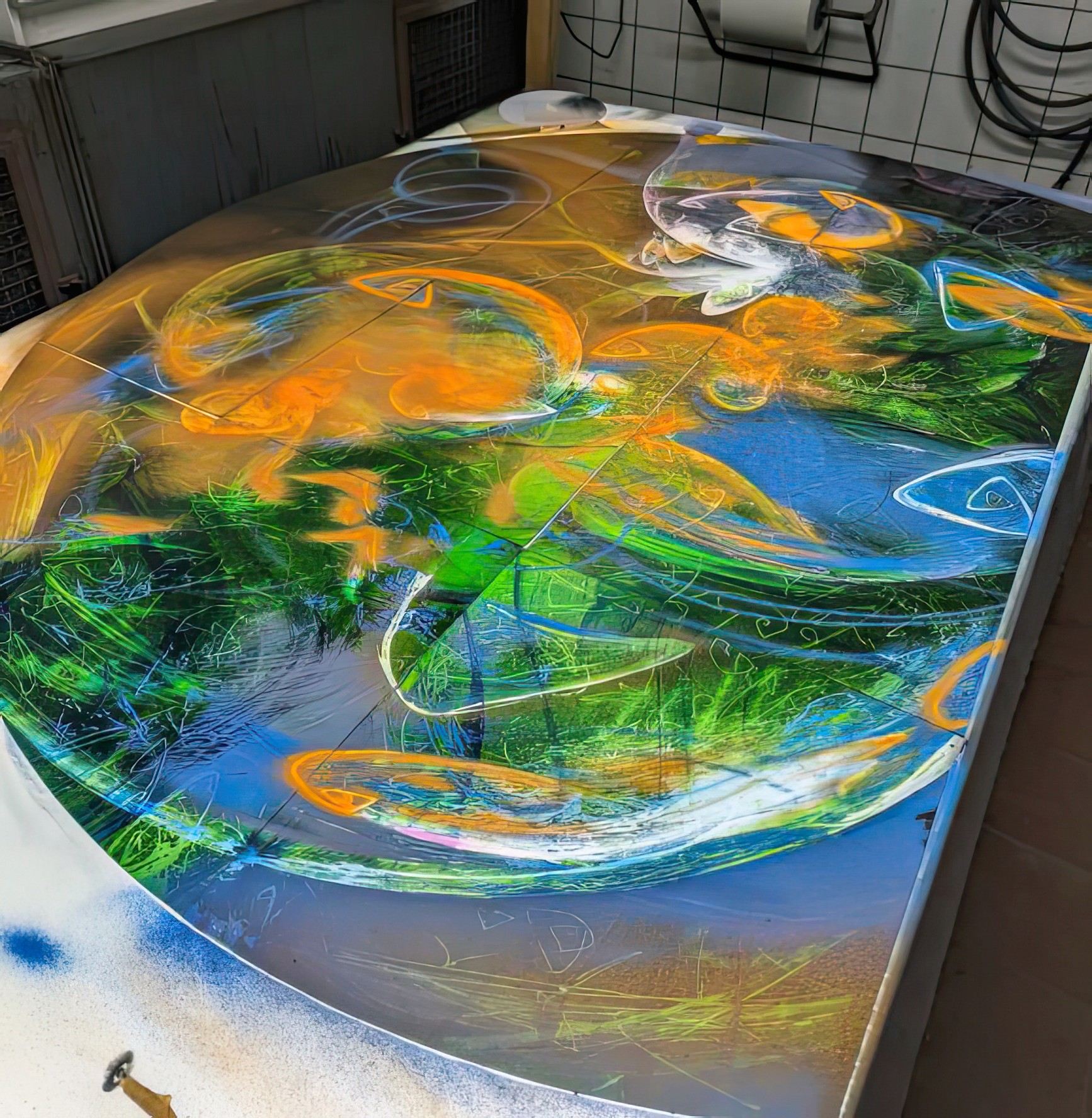
With each firing the risk increases for color shifts to occur, but the richness of multiple layers of color is important as well. Multiple firings achieve the nuance and layering I am after, building the surface layer by subtle layer, as in a watercolor.
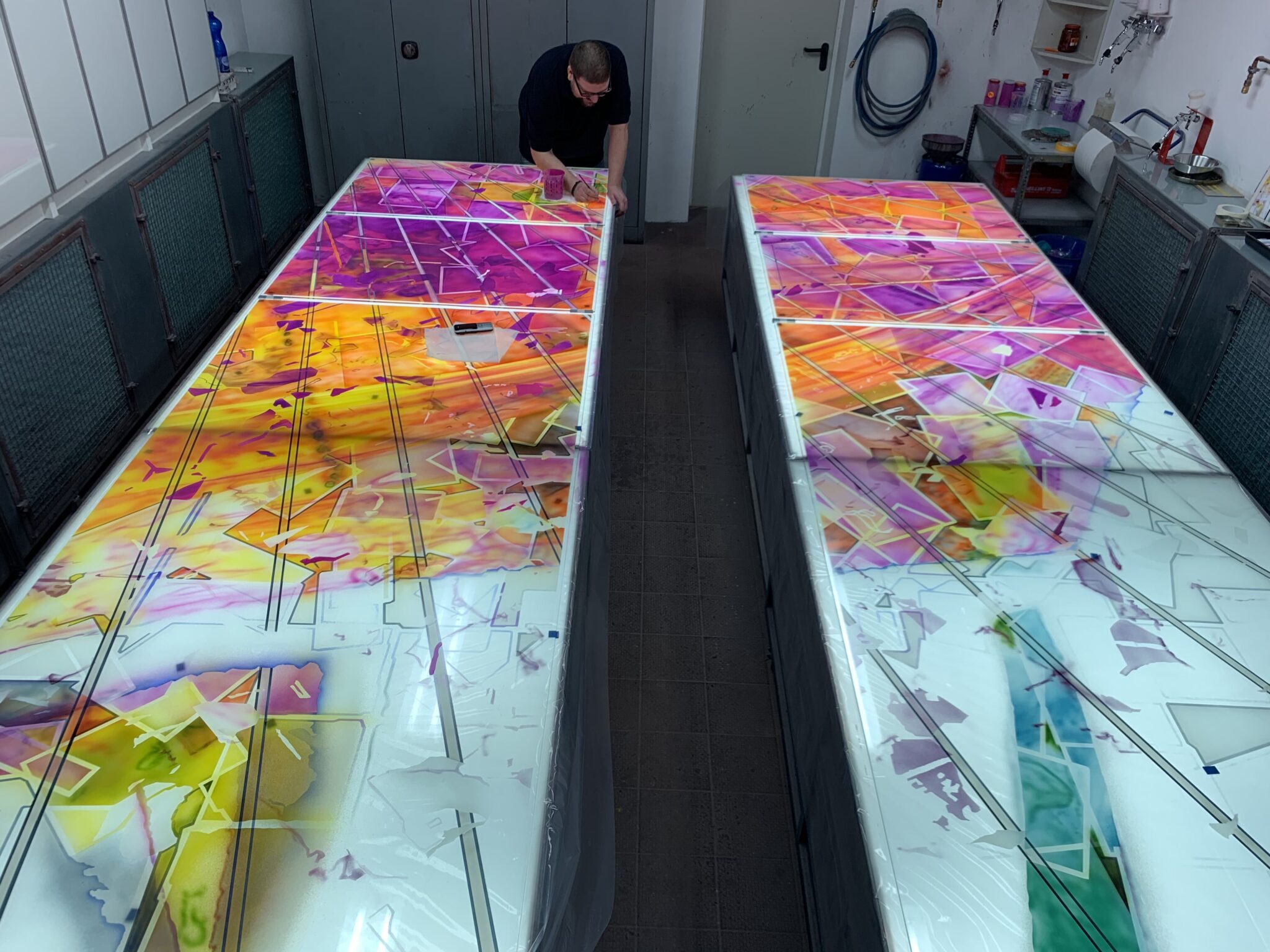
Airbrushing is used for fields of color and soft edges, or with stencils to create hard edges. Painting with brushes and vitreous enamels is often done as well.
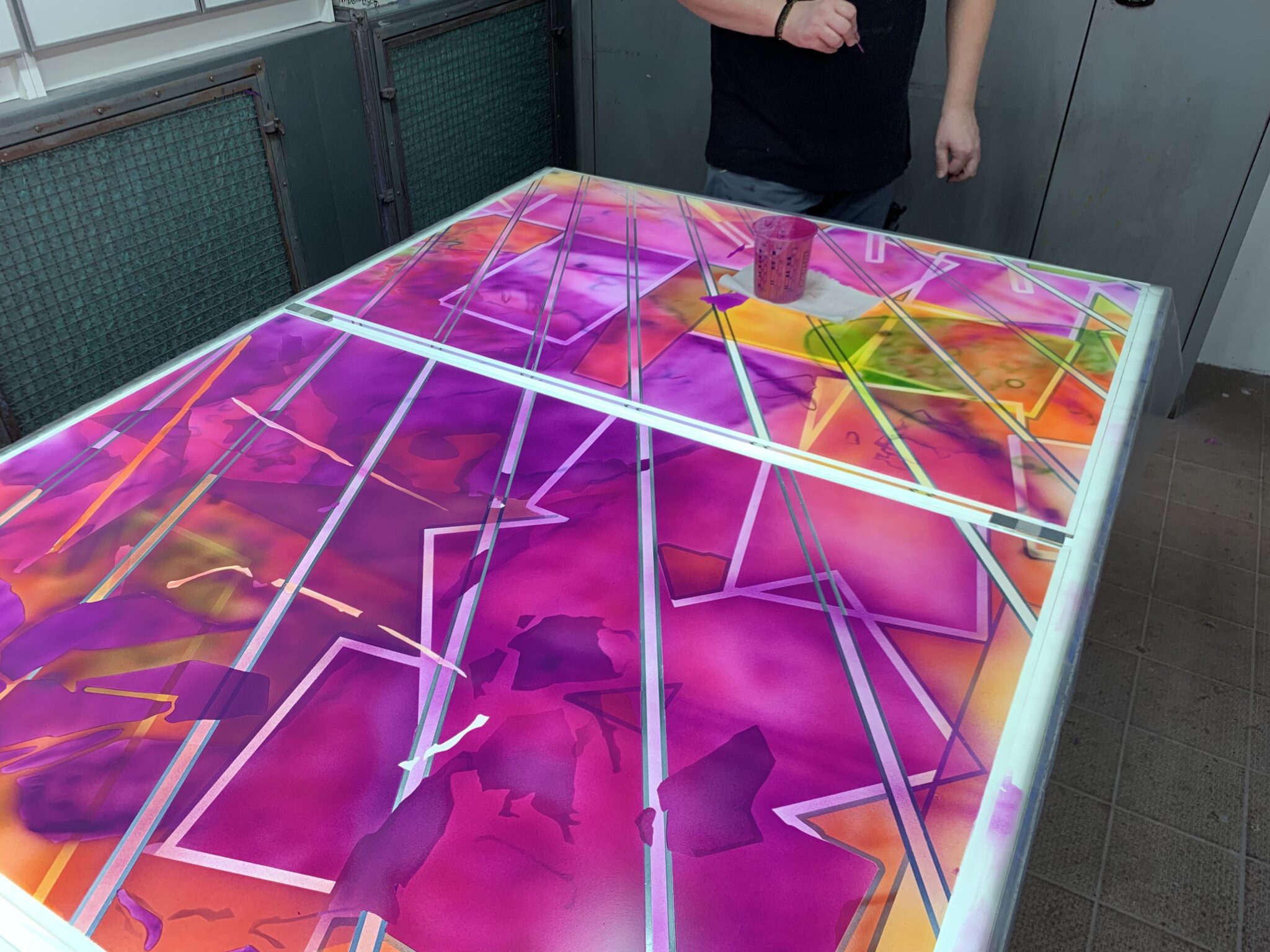
The antique glass can be painted on one or both sides, and antique glass can be layered by laminating one piece on top of another to intensify the color, building up layers of depth that would be impossible to achieve any other way.

Once the antique glass pieces are painted and fired, there is the option of adding another layer of color by painting and firing the carrier panel of float glass as well. This has to happen before the lamination begins. The carrier glass, if painted, is typically painted on one side only, as the entire laminated unit must pass through a commercial tempering process.

Laminating the antique glass to the carrier panel is a technique pioneered at Derix, and is as much a stylistic choice as a technical one. Without lead came, there are no black lines to interrupt the flow of shapes and imagery. Light moves through the work unbroken, continuous, alive. This brings a very contemporary feel to the stained glass, and a quality of light much closer to watercolor.

The finished panel meets architectural and building code requirements and can be built directly into an insulated glass unit, or used to create a third panel on the interior of the building alongside an existing insulated glass unit. I have done several projects now where the transition between stained glass and clear plate glass on a building exterior is a slow fade into transparency.


The Studio and Its People
Founded in 1866, Derix is now in its fifth generation. This studio created stained glass for the two largest cathedrals in Europe. At any given time, artists from around the world are working there, each collaborating with a team of glass painters, cutters, acid etchers, airbrush artists, and restoration specialists, each of whom has spent a lifetime developing a single skill at the highest level. That depth of craft makes it possible for an artist to bring an idea into glass without compromise. You are not limited by what you can do alone. You are supported by what a team can do together, each person a master of their part of the process.
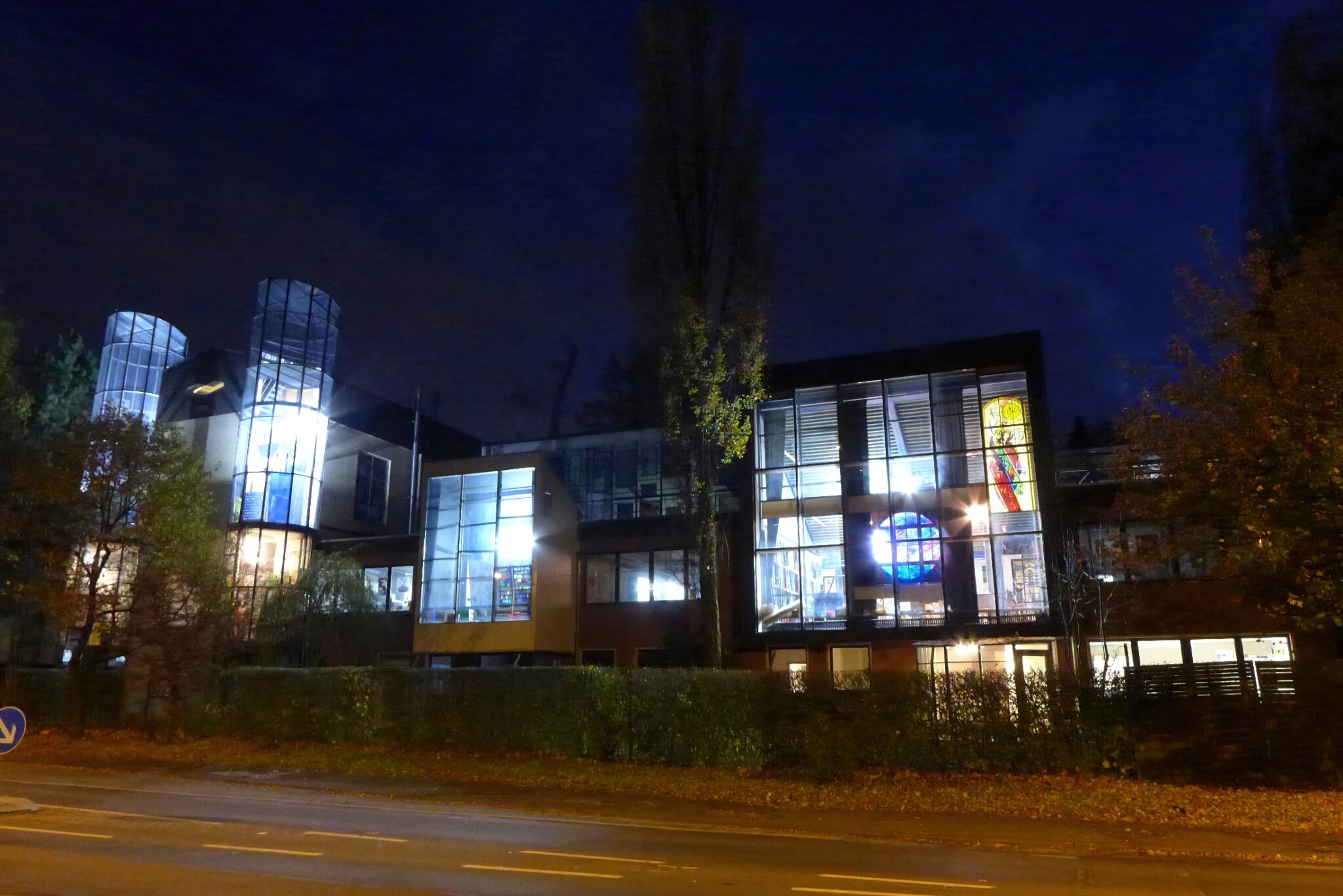
Wilhelm and Brigitta Derix, who together built so much of what Derix is, have since retired. Wilhelm believed that an artist should not limit the possibilities of their work through limited skills. For this reason the studio exists, to realize the nearly unlimited possibilities of an artist’s ideas in glass. That philosophy is still present in the studio today.
The studio is now led by Rainer Schmitt. Frederik Richter, with whom I have worked from the very beginning of my time at Derix, is still there. Anna, Barbara’s niece, is the person I work with most closely now. She is kind, patient, thorough, and so completely attuned to what I am trying to do that she takes care of everything. The family feeling of the studio has not changed. Brigitta cooked meals from her garden. Whatever vegetables were in season provided the idea for the meal. Around the family dining table upstairs, artists from around the world sat down together and talked. Conversations ranged widely from biking routes in France, the mythology of the American cowboy, to the work being made downstairs, but at 1:00 pm sharp, Brigitta would say: now back to work.

Over the years I have come to understand, by being at Derix, the history of modern glass. I met Kim en Joong there — a Dominican priest and painter who was making completely abstract windows for what Wilhelm told me was the oldest Romanesque church in France. The combination of those ancient walls and gestural abstract brushstrokes is amazing, how naturally they belong together, how the one seems to call for the other. Johannes Schreiter was generous enough to meet with two different groups of my students over two separate January interim trips, and to look at their work. His relationship with Derix goes back more than sixty years.

One time at Derix, I watched Johannes Schreiter’s windows being fabricated for the Peterskirche, St. Peter’s Church, Heidelberg’s oldest church, which has served as the university chapel since the Middle Ages. On a later visit to Germany, it was a thrill to see those same windows installed in the church. German art historian Holger Brülls has written that no other living artist has embodied modern stained glass as Schreiter has. To have met this glass master, and to go to his studio, and have him meet with my students—and then to watch his glass go into that church, felt like witnessing a piece of history.
Other giants of German glass, both Ludwig Schaffrath and Georg Meistermann worked with Derix as well. I was in Germany when Ludwig Schaffrath passed away, and I remember Barbara lamenting that history was passing too.

For a time, I was questioning whether I belonged in a place with such giants in glass. Then one day Johannes Schreiter looked at one of my windows I was working on and said in German that the color was exactly right. After that, I felt like it was okay to be there in the studio.

The people I work with day to day at Derix are a generation or so younger. My collaborator at Derix is master glass painter Olaf Hanweg. We have worked together for nearly twenty years. He knows how I think. He knows when to follow my design precisely and when to bring his own judgment. Karl Heinz Traut, now retired, managed most of the projects I have done at Derix over the years and has traveled to the United States to help install the work. Erik Feltes has installed my windows on site, and Johanna Feltes who has cut the glass, work that requires extraordinary precision and a deep reading of the design.

Others from the studio have made the journey to the United States. For the dedication of Our Lady of the Angels, the Franciscan Renewal Center flew Olaf and his colleague Roman Olichowski, who did much of the acid-etching on those windows, from Germany to Arizona to be present for the blessing.
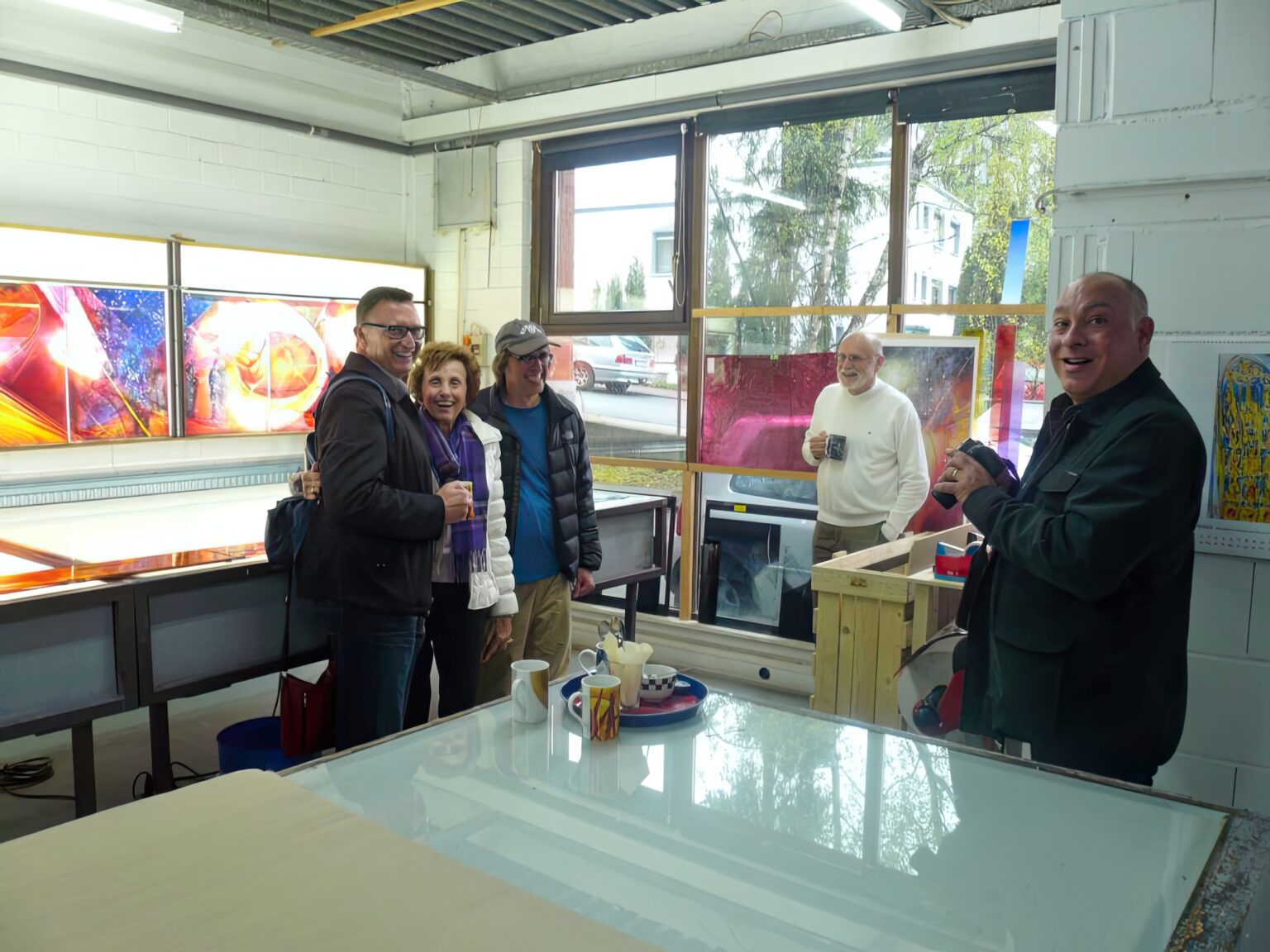
And the traffic goes both ways. Several parish communities have sent leadership and committee members to Taunusstein during fabrication to see the work taking shape, and I have twice brought my own students to make small windows at Derix during January interim terms. When you commission a window, you are entering a relationship, and you are welcome inside it.
What Collaboration Actually Means

One of the things I have come to love about working with Olaf is watching how he approaches a difficult passage. He doesn’t rush. He stands with the image, sometimes for a long time, until he understands what it needs. For the Holy Spirit window at Gloria Dei, I had brought him a gestural, somewhat abstract image of a dove in motion, with a suggestion of flame. He stood in the studio looking at it. Then he walked outside and picked up a handful of rocks from the ground, laid them on the glass, and airbrushed around them for texture. Then he tore a t-shirt into strips and assembled a dove from the torn cloth to use as a stencil for the silver stain. A paper stencil would have left too harsh of a sharp edge. The torn fabric and irregular soft edges provided exactly the softness the image needed, suggesting the dove as the Spirit in motion.

In the studio, there are no creative guarantees. You wrestle with the image, sometimes for a long time. You have to be present. You have to pay attention.

Glass painting asks everything of the glass painters. It asks your attention to every mark, every edge, every intention behind the image. It asks for presence and patience—the willingness to stand with a problem until the answer arrives, even if the answer is a handful of rocks and a torn shirt. And it asks an openness to what cannot be controlled from a bit of play with brushstrokes in the binder, the firing that shifts in the kiln, the window that falls and shatters, the brokenness that becomes, in the end, a gift. That arc, from craft to spirit to grace, is what this collaboration has taught me.

Why I Work in Germany
To understand how I came to work in glass, it helps to go back. When I was twenty years old I went to El Salvador to volunteer at an orphanage, in the middle of a civil war. I had a camera with me, and one day I took a photograph of the children eating lunch upstairs. The kids were seated at a long table in a way that reminded me of Da Vinci’s Last Supper. The child at the center held a gesture of Christ, with light pouring in from the window behind him. Looking back now, I can see I was already aware of how light changes everything, how it brings a kind of sacredness to a space.

My first work in glass was not stained glass, but constructed from architectural plate glass. It was a solstice marker, a 450-pound block of precast concrete with an opening in the shape of a spiral and glass set into the wall. It was a State of Colorado commission, made in collaboration with Klipp Architects for the Center of Southwest Studies at Fort Lewis College in Durango, Colorado. I had been thinking about the play of light and shadow in the Southwest landscape—the way the ancient peoples of the region built solstice markers and lunar alignments into their architecture, the way even small structures carry these markers. At Hovenweep, the sun creates a dagger of light across three spirals on the cliff face at the summer solstice. I wanted to reverse that and bring the sun back inside, to make the sun a return visit to the museum.
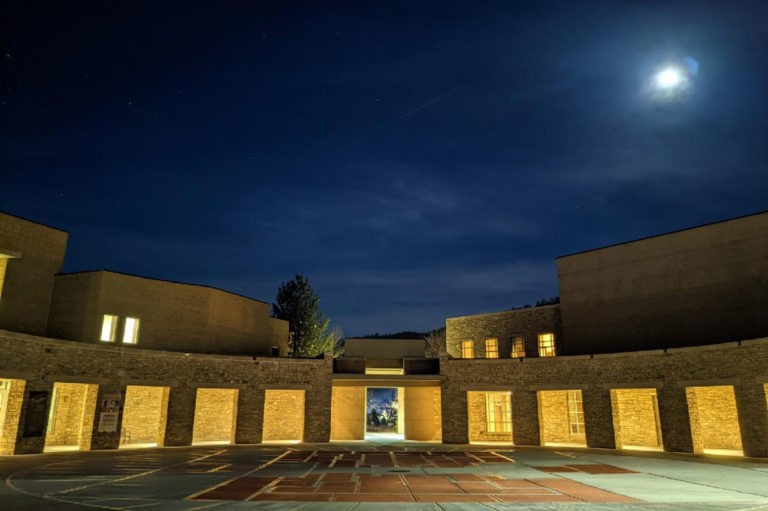
To get the alignment right I worked with astronomers, satellite engineers, and survey crews. And now, each summer at sunrise, sunlight enters the spiral and collimates a shaft of light across the Great Hall. The spiral appears on the opposite wall almost instantly, fully formed, as if a switch has been thrown. For ten or fifteen minutes it moves slowly across the wall, and then it is gone. People still come out each summer before dawn on the solstice to witness this event, more than twenty years later.

Years later, I was approached by architects to design clerestory windows for a major addition to a Lutheran church. The project never came to fruition, but in my research I contacted Barbara Derix, who was in the United States at the time. She took my call. She took me seriously. We spoke for an hour or more — and I only had that one prior glass commission. She didn’t need to give me that kind of time. Barbara understood immediately what I was saying about light and my design. She is brilliant, and generous in a way that has characterized every relationship I have had with that family. I thought: if I ever do get a glass commission, I want to work with Derix. It is one of the best decisions I have ever made.

Barbara taught me glass. She was my mentor, and I would not be where I am today without her guidance and generosity over all those years. My family was able to visit the studio at Barbara’s invitation; and Barbara and her niece Anna visited us in Sioux Falls. Barbara also stayed with my parents in Denver. That generosity has been present from the first phone call.
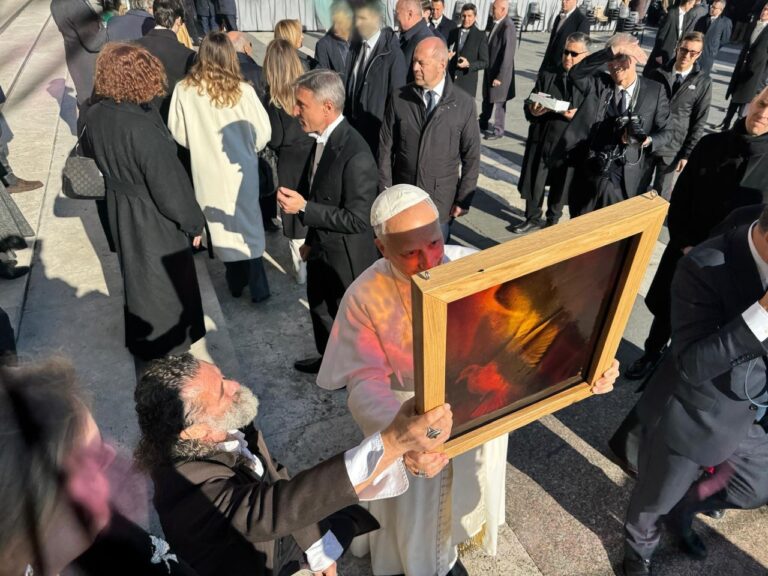
My friend and fellow artist Yvelle Gabriel is a German glass artist whose life’s work has been shaped by reconciliation: a synagogue in Israel, a peace window in Poland, work recently presented to the Pope. He once told me that his own grandfather had been a Nazi. He carries that inheritance and answers it with beauty.

Photo by Flocci Nivis
Yvelle and I went together to see the Chagall windows at St. Stephan in Mainz. It was fitting to be visiting this church with Yvelle. It's a place he knows well and returns to often. It was at St. Stephan that Chagall, a Jewish artist who had fled occupied France, agreed, after years of persuasion, to create windows in Germany as a symbol of Jewish-Christian reconciliation. He worked on them until his death in 1985. As Yvelle and I were about to leave the church, a small taxi pulled up. Yvelle said: wait, let’s see who gets out. It was Monsignor Klaus Mayer, the pastor who had spent decades persuading Chagall to come to Germany, the father of those windows, who in his nineties, was still coming to the church several days a week. He spoke with us briefly and kindly. To speak with the man who had made all of that possible made me feel just a bit closer to this history of glass.

During the fabrication of another commission, the window of St. Michael fell from the viewing tower. Olaf caught it for a moment but then he could not hold on, and it fell and shattered. Monsignor Buelt was present when the window fell, and he speaks of that moment as evidence of a spiritual battle. And we had to start over. At the end of the project, Olaf put the broken pieces back together and gave me the window as a gift. It seems fitting that the defender of the church would have fought a few battles and carried a few scars.

The Sister Mother Earth Window I designed for the Franciscan Renewal Center in Paradise Valley, Arizona was one window initially, then a generous donor stepped forward to sponsor all the other panels. Stained glass is a collaborative process from beginning to end.

There is a guest book at Derix that visiting artists have signed over the years. One entry, from 2007, by the American artist William Cochran, is titled “Prayer for the Glassworkers.” He recalls through his poem a very human moment where artist and glass painter bridge a language gap through the humility of the glass painter, and their openness to the beauty they’ve created together, imagined as a small boat on an indigo glass sea. This becomes a prayer to humility, and beauty, and wonder. And it leaves me with a way to bring this story to a close.

Derix has been a place where my spirit is renewed in the presence of great artists, working collaboratively with color and light. The windows that have come out of this relationship are more than I could have made alone — more, honestly, than I could have asked for. You are transported by evidence of the process. Looking into a piece of glass, you feel as though you are crossing a threshold of colored light into another world. Nearly twenty years of working together has felt like that.
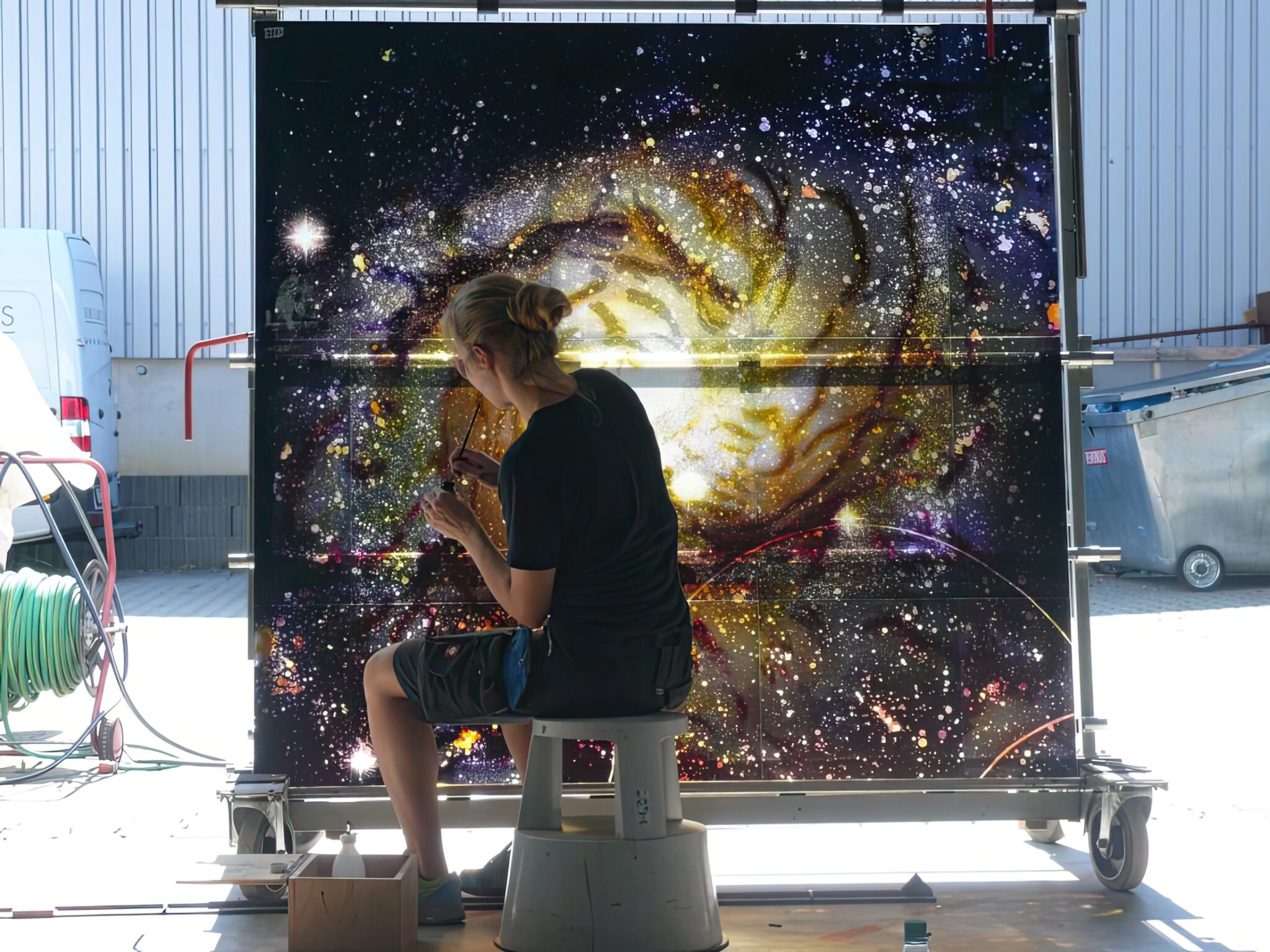
What has come back to me, through all of it, is a gift I am still grateful for: the chance to bring beauty into spaces where people are already open—where the light through a window can stop you, lift you, and open something you did not know needed opening. Work that consoles and transports. Work that makes the sacred feel present and alive. Work that, on the right morning, with the sun at the right angle, can take your breath away. That is what I hoped for, and what this collaboration has made possible.
