Learning to Fly
2010
·
Edmonton, Alberta
Sector
Public Art
Client
University of Alberta
Architect
ONPA, Flad Architects
+ Awards

The title comes from Tom Petty — not from me, but from the Dean, who used it in his dedication of the building from his family to the students. It is exactly right. Learning to fly is what a university is for.
When I begin a project like this one, I try to understand what will happen inside the building before I design anything. When I asked the Dean what research the faculty conducted at the Centennial Centre for Interdisciplinary Science, he said: we do everything in science. Three hundred faculty. If it’s being done in science, we do it here. (The fields brought together in the building include Integrated Earth and Landscape Management, Nanostructures and New Materials, Resource Geosciences, Chemical Biology and Proteomics, Planetary Dynamics, and Physics.) That answer opened the floor to the whole world.
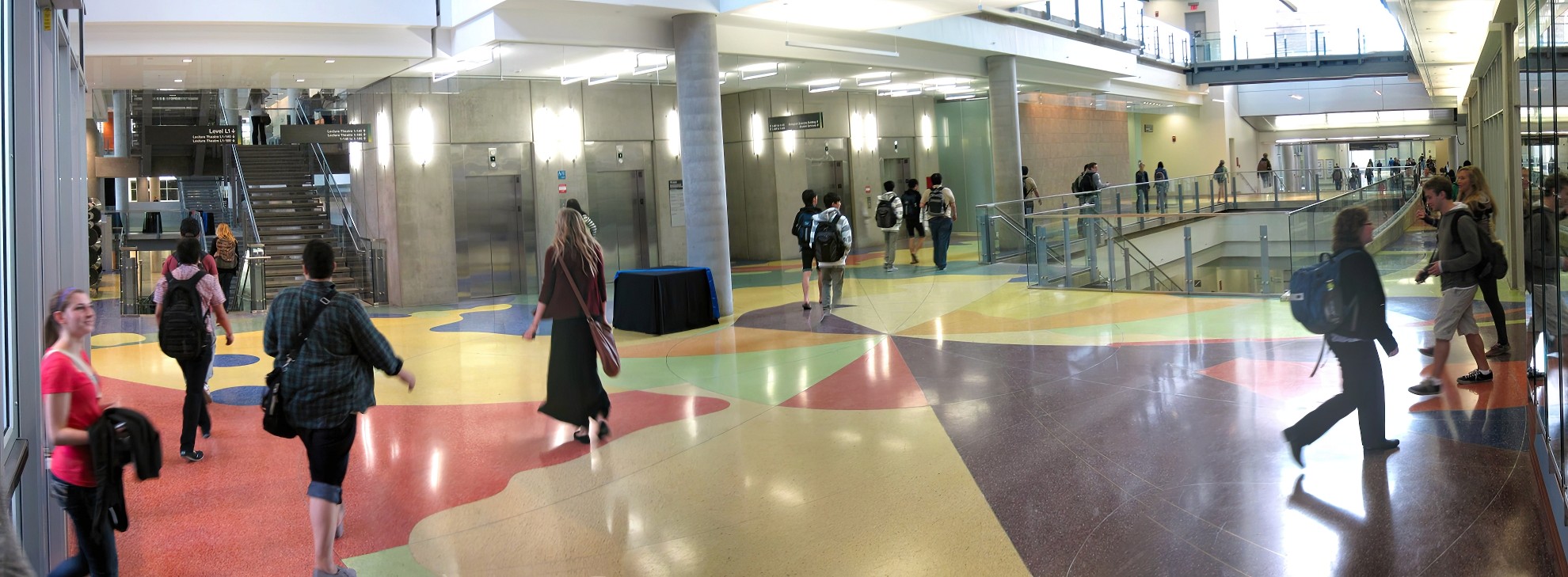
The design reflects the scientific research conducted at the University of Alberta — from neurons to nanostructures, from subatomic particles to planetary dynamics, from fractals to the stars. The plesiosaur that runs three hundred feet through the floor came from a particular kind of attention. A friend and I had found small fossilized bones protruding from a trail in the southern Black Hills of South Dakota — remnants of the great inland sea that once covered that landscape. The University of South Dakota School of Mines excavated the site. It turned out to be a plesiosaur, and that tail is where I first encountered one. Alberta is famous for dinosaur fossils. The Dean had told me they did everything in science. So I put a plesiosaur in the floor.
When I was showing the Dean the preliminary drawings, he stopped at the plesiosaur and asked if I knew they had the world’s foremost plesiosaur expert on their faculty. I had to admit I didn’t. But there it was.
The floor covers nearly 40,000 square feet across multiple passageways and levels, with more than seven miles of divider strip and over 5,000 gallons of epoxy poured. The aggregates include crushed windshield glass, mining byproducts, and various marble — materials chosen in part for their contribution to the building’s LEED rating, and in part for their beauty. Ten epoxy colors move through the composition, shifting as you move through the building.
Part of the building curves in response to the shape of the North Saskatchewan River, with a glass curtain wall that opens the interior to the landscape outside. That relationship between inside and outside became one of the animating ideas of the floor. Looking north through the theatre windows toward the river, you can see fluid dynamics in the water’s flow and find it echoed in the forms at your feet. Ice crystals forming on the glass outside connect to a diffusion-limited aggregation fractal embedded in the floor below. The seasonal migration of birds visible through the curtain wall finds its correspondence in the symmetry of patterns in the terrazzo. When that moment of recognition occurs — when the world outside and the floor beneath you are suddenly speaking the same language — the building becomes something more than a building.
I love fractals. They are among the most beautiful things in mathematics, and terrazzo is like a giant coloring book of shapes — wherever the research suggested one, I looked for a way to put it in.
After the project was complete, one of the architects from ONPA invited me to fly back with him in first class on his frequent flyer miles. It was the first time I had sat up front. We had a lot to talk about.
“A human being is a part of a whole, called by us ‘universe,’ a part limited in time and space. He experiences himself, his thoughts and feelings as something separated from the rest — a kind of optical delusion of his consciousness. This delusion is a kind of prison for us, restricting us to our personal desires and to affection for a few persons nearest to us. Our task must be to free ourselves from this prison by widening our circle of compassion to embrace all living creatures and the whole of nature in its beauty.”
— Albert Einstein