Foucault’s Dream
2016
·
Sioux Falls, South Dakota
+ Project Details

Froiland Science Center, Augustana University, Sioux Falls, South Dakota
Terrazzo, cast bronze, cast glass, LED, epoxy resin
With artist David Griggs
When I was a kid, I would stand at the Denver Museum of Natural History and watch the Foucault pendulum. You could wait fifteen minutes for the bob to knock over a pin — and then turn away at exactly the wrong moment and miss it, and have to wait another fifteen minutes. There was something wonderful about that patience, about the slow evidence accumulating in front of you that the earth was turning beneath your feet. But I also learned, much later, that most pendulums require a motor to keep them moving. That felt disingenuous to me. The magic of a Foucault pendulum is that it doesn’t need any help. It is simply doing what physics does.
So when the president of Augustana asked me to reimagine the pendulum in the science building — the building was undergoing a major renovation — I knew a few things immediately. I didn’t want to make people wait fifteen minutes for a pin. I didn’t want a motor. And I wanted the pendulum visible from outside the building, readable from a distance as a beacon, not just a curiosity you discovered by looking straight down.
The original pendulum had a motor that had long since broken, and the bob was a shotput borrowed from the track team. But alumni had grown fond of it the way you grow fond of almost anything from your college years — not because of how long you knew it, but because of who you were becoming when you did.
I called David Griggs, a friend and neighbor from my years in Denver whose work I had admired on two previous pendulum installations — we had collaborated on other projects as well, some of which appear elsewhere on this site. We began designing together. Then, because we had to, we found another way: we brought in two physics professors from the campus and worked with them to design our own drive mechanism using supermagnets. It cost less than a thousand dollars. It works.
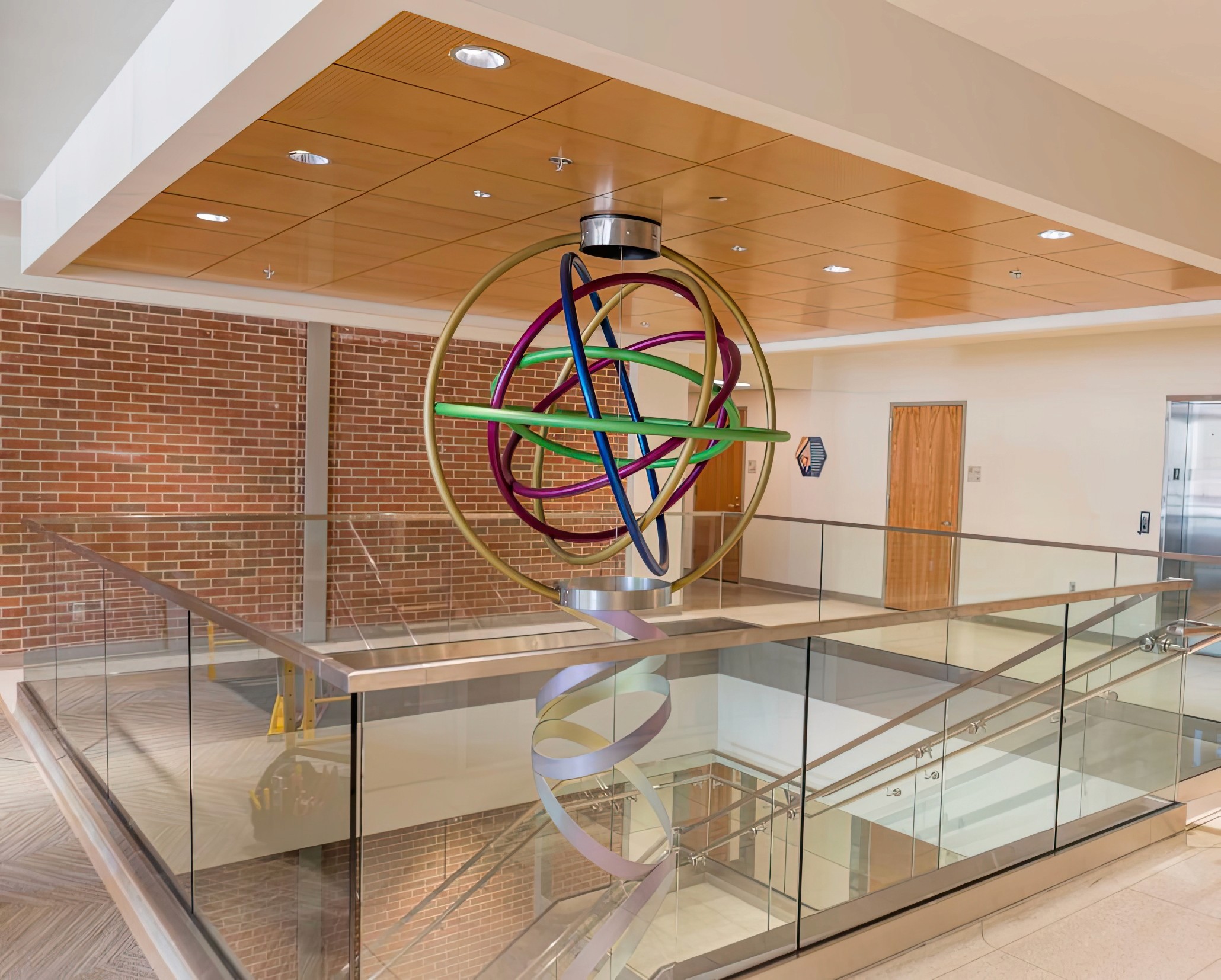
The installation rises three full stories through the entrance stairwell. At the top, a sphere of interlocking colored hoops — gold, blue, green, violet — turns the origin point of the pendulum into something you can see from the street. This image came to me from Bruce Cockburn’s song
Hoop Dancer
, which I have loved for years. Cockburn sees the hoop dancer as something like a living magnetic needle, aligned between deep past and looming future — and at the end of the dance, the hoops combine into the form of the globe itself. That is what sits at the top of this pendulum: the earth, suggested in hoops, the motion of the dance resolved into a sphere. Sioux Falls sits on land most recently belonging to the Lakota people. The connection felt true and necessary, not decorative.
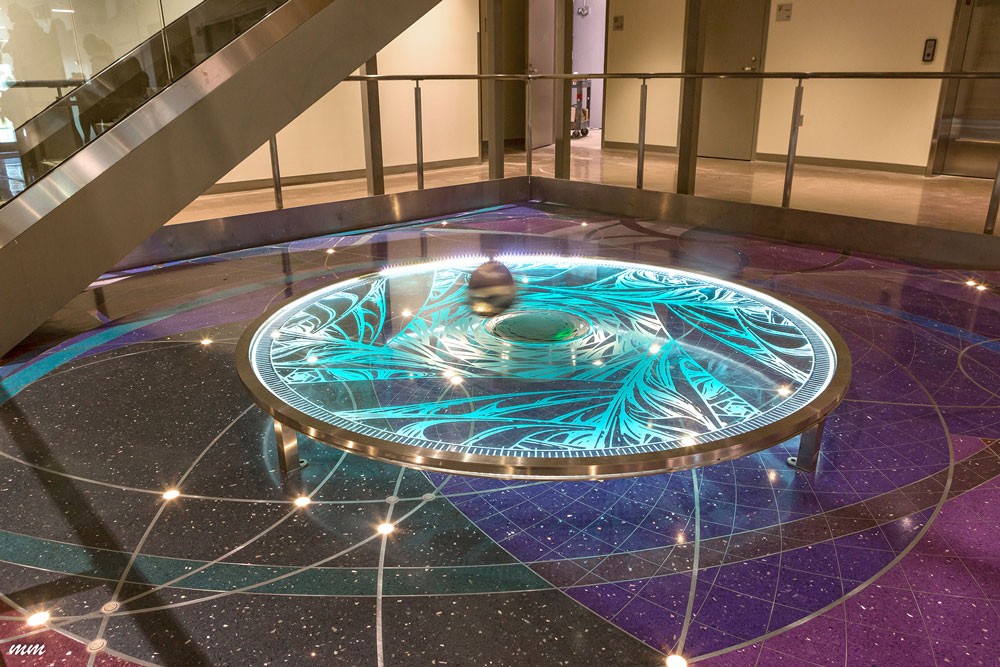
Below the sphere, a series of iridescent conical rings descends along the pendulum’s vertical axis, tracing the full arc of its swing. The 110-pound cast bronze bob, inscribed in relief with the spiral movements of its own precession, catches light as it passes.
At the base, a three-tiered terrazzo floor in seventeen colors forms a field of orbital and celestial imagery. Forty-five LED lights are embedded in the tiers, programmed to respond to the pendulum’s motion — turning on and off as the bob swings, so that the floor twinkles like a reflection of stars in moving water. A cast glass disk etched with fractal geometries sits at the center. Fractals — forms that repeat at every scale, from the subatomic to the galactic — felt like the right language here, because a Foucault pendulum is itself a fractal argument: the same physics, playing out at the scale of a building, that governs the motion of planets.
Science and art share this thread. Both point toward the interconnectedness of things. Both ask the deep questions in their own language and find, sometimes, that they are asking the same question.
At the end of
Fanny and Alexander
, Bergman gives us a line I have carried for years — about imagination spinning out and weaving new patterns above the tenuous ground of reality.